About a Military Dictatorship, Amnesty International, and the Emergence of Authoritarianism in the United States
Speech delivered by Nestor Fantini in San Diego during Amnesty International USA´s “Write for Rights” Campaign on December 7, 2025

Hello. My name is Néstor Fantini, and I am a survivor of the Argentine military dictatorship of the 1970s.
I want to invite you to travel back almost fifty years, to another continent and another time, as an exercise in imagination and empathy. If we make that journey together, I think we will begin to see the connection between what happened under a South American dictatorship and the disturbing signs we now see in our own American democracy.
It was December 1976. I was a young student and worker, held as a political prisoner in UP1, a prison in Córdoba. That morning, soldiers came into the cell block carrying a list of names. My name was on the list.
We were handcuffed, forced onto our knees, and ordered to pray.
“De rodillas, de rodillas y a rezar… In your knees, in your knees, and pray… ‘Padre nuestro que estás en los cielos, santificado sea tu nombre’…”
Then they dragged us to waiting trucks, beating us, threatening death. For forty, maybe forty-five minutes, we drove through Córdoba and then the outskirts of the city, not knowing where we were going. We arrived at a place where the air shook with the roar of powerful engines. It was a cargo plane.
We were lined up in groups, chained together, and loaded into the plane. And then we waited. We waited what felt like an eternity. At last, the engines roared louder, the floor trembled, and the plane lifted into the sky with its human cargo. We were leaving Córdoba. We were heading toward the unknown.
I was afraid -truly afraid.
The Military Coup d’état
Let me give you some context. Only nine months earlier, on March 24, 1976, the military had carried out a coup d’état. The democratically elected president was arrested. Congress was closed. Political parties were banned. Judges were replaced. Task forces made up of military and security forces were kidnapping people and taking them to clandestine centers of detention, where torture was routine -a daily method for extracting “intelligence.”
Around 30,000 people were “disappeared,” a euphemism for being extrajudicially killed. In U.S. terms, that would be like executing about 300,000 Americans. Among those disappeared were high school students as young as fourteen, workers, housewives, lawyers, doctors, priests. About 500 babies were taken from imprisoned mothers and handed over to friends and relatives of the military. Many prisoners were flown over the ocean and thrown alive into the water.
So, that December day, inside that cargo plane, I was terrified. I was sweating, and my whole body was trembling. I felt like I was going to throw up. For months, I had already been humiliated, beaten, tortured. I had watched fellow prisoners executed in the prison yard. But I had never imagined that everything could end in the dark belly of an airplane.
And yet, there was light at the end of the tunnel. We believed we were flying toward our deaths, but in a cruel twist of events, that flight meant the opposite. We did not know that we were being transferred from Córdoba -a military district under the control of the ferocious General Luciano Benjamín Menéndez- to the southern region of Buenos Aires Province, controlled by a somewhat less brutal general. Our chances of survival, without our knowledge, were actually increasing.

Amnesty International
In total, I spent 1,403 days as a political prisoner in several prisons, never convicted of anything. I passed through the cells of D2, UP1, Sierra Chica, and La Plata. There were moments of deep darkness, when it felt as though the world had forgotten we existed.
Then, sometime in 1977, I received news that Amnesty International had adopted me as a Prisoner of Conscience.
Get Nestor Fantini’s stories in your inbox
Join Medium for free to get updates from this writer.
Wow! It was as if a beam of light had pierced the walls of my cell -a burst of hope entering a universe built on State terror.
That news meant that somewhere out there, people knew my name: Néstor Fantini. I was no longer just a number in a file. I had become part of a global network of people who believed in human rights, in dignity, in justice.
In my case, that hope had a very specific name: Mary Evelyn Porter, “Mev” -an Amnesty International volunteer and Ph.D. student at the University of Texas at Austin, who coordinated the group working on my behalf.
I cannot measure what hope means in those conditions. There are no formulas, no graphs, no statistics that can explain it. But I can tell you this: hope saves lives.
And that is why I want to thank all of you here today, on this “Write for Rights” day. By being here, by choosing to write a letter, send a message, or sign a petition, you have chosen hope. And when I think of hope, I remember the words of Maya Angelou: “Hope and fear cannot occupy the same space. Invite one to stay.”
Today, you are inviting hope to stay. Your words will travel far beyond this room. They will cross borders and walls and barbed wire and find their way into cells in places like Myanmar, Saudi Arabia, China, Israel, Nicaragua -and yes, even here in the United States.
You are messengers of hope.
Warning Signs
After I was released in July 1979, I came to North America. I married Mev, the Amnesty International volunteer. We had a son. I finished college. I worked for more than thirty years as an educator. I stayed involved with Amnesty groups.
So, I began to build what many would call a “middle-class life.” Everything seemed normal. There were good and bad times, like in any life, but things felt more or less reasonable.
Then, slowly, I began to sense something unsettling happening in this beautiful country of Jefferson, Madison, and Lincoln -this country born of the American Revolution, of ideas about democracy and civil rights that inspired the world.
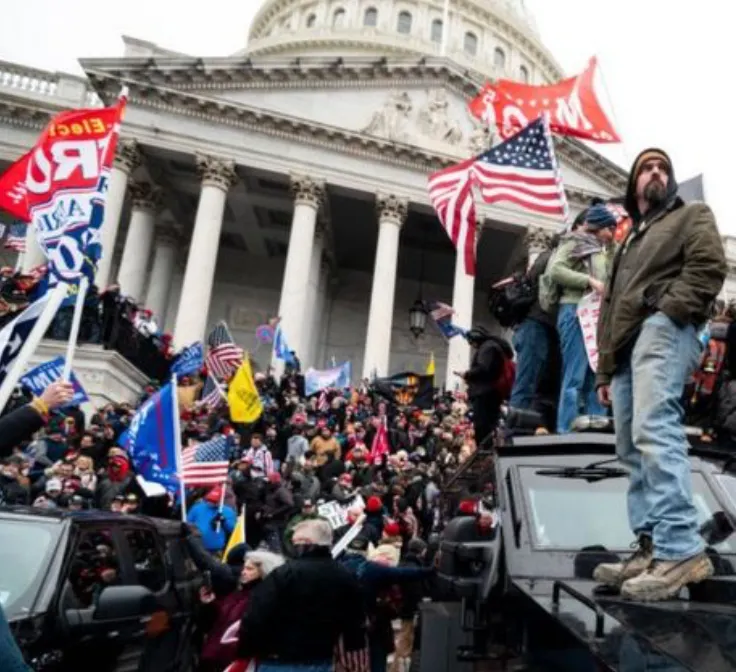
I started to hear talk of an “invasion” by immigrants. I heard of culture wars. I saw neo-Nazis with their torches of hate marching openly in Charlottesville. I saw science replaced by opinion. Books being banned. Students protesting injustice being arrested. I saw law firms, universities, and the media being threatened and discredited.
And then I saw masked men in unmarked SUVs, in Los Angeles, Chicago, New Orleans, and other cities, arresting people in the streets, at their homes, at their workplaces, at schools. They called them criminals, but the overwhelming majority were simply workers -men, women, teenagers- who had come to the United States fleeing wars and hunger in pursuit of the American Dream. They were sent to detention centers far from their families, their lawyers, their judges. Hundreds of thousands were deported, some to dangerous places like El Salvador, Sudan, and Eswatini.
And a mantle of fear fell over major American cities.
Now, when I walk the streets of Los Angeles, I sometimes feel an echo of the fear I knew in Argentina in the 1970s, when the military kidnapped, tortured, and killed. We are not yet at that point, but it feels like chapter one of the same authoritarian story.
And yet, despite the fear, despite the erosion of civil rights and basic decency, we cannot surrender to fear. We must stand up. We must defend our democratic institutions, our social and political achievements, our fragile but precious freedoms. These are trying times. They are also times when we show the integrity of our moral convictions.
Dr. Martin Luther King Jr. once said: “There comes a time when silence is betrayal.”
For many people around the world, you are the difference between silence and solidarity. Between invisibility and recognition. Between despair and a small, stubborn spark of hope.
When you write your letters today, remember there is someone, somewhere, sitting in a cell, waiting for hope.
Thank you for choosing hope. Thank you for refusing silence. And thank you, from the bottom of my heart, for writing for rights.
Thank you, Amnesty International!